
Fathom action items can speed up follow-up. They should not be treated as final without review.
AI meeting notes can miss ownership, merge separate tasks, or phrase internal thoughts as customer commitments. A checklist keeps the follow-up useful and safe.
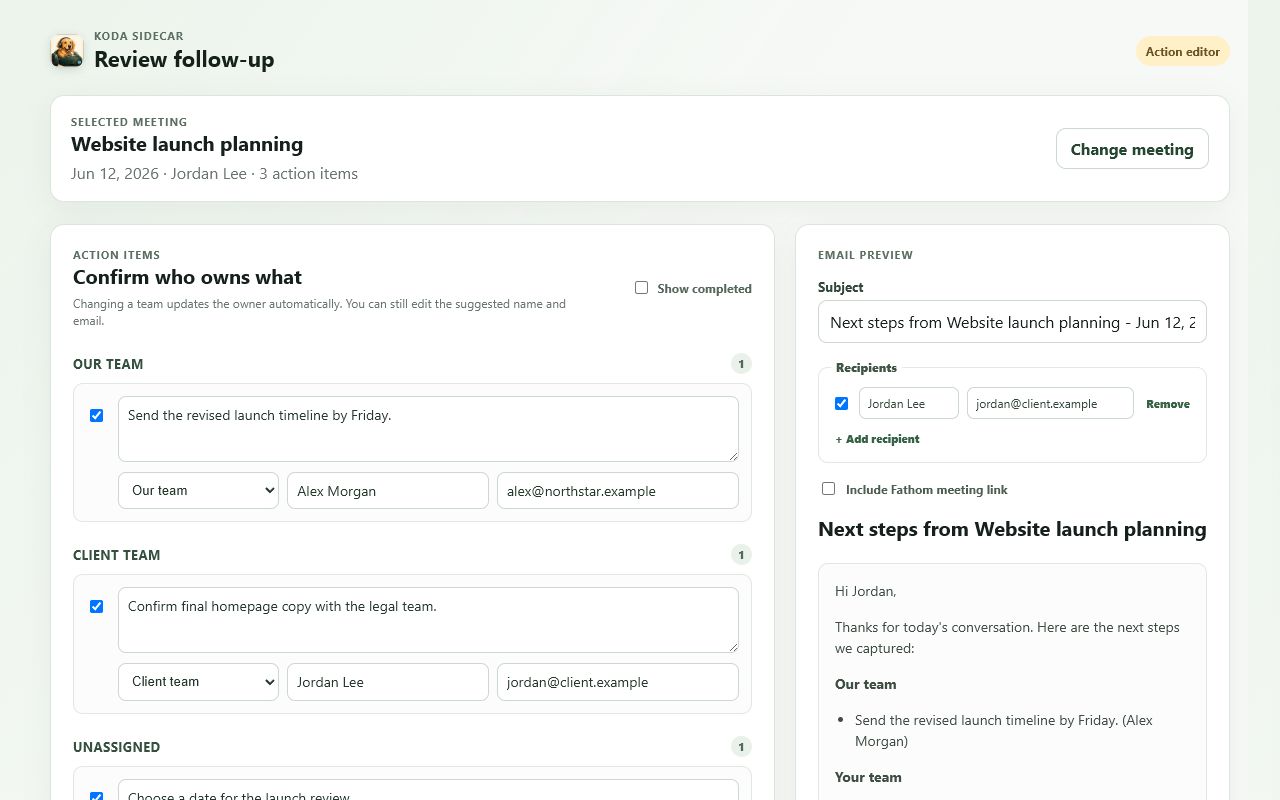
Screenshot: Koda Sidecar reviewing synthetic Fathom action items before drafting follow-up.
Review the Owner
Ask:
- Who actually owns this?
- Is the owner internal, customer-side, vendor-side, or shared?
- Did that person agree to do it?
- Is the name or email correct?
- Should the owner appear in customer-facing follow-up?
Do not turn a discussion point into a customer commitment unless the meeting supports it.
Rewrite Vague Tasks
Weak action item:
Follow up on login.Better:
Support will compare the failed SSO HAR against the IdP logs and update the ticket by Thursday.Good action items have a verb, owner, object, and outcome.
Separate Customer-Facing and Internal Items
Some tasks should not go into the customer email.
Keep internal:
- Debugging speculation.
- Account risk notes.
- Internal escalation comments.
- Pricing or renewal concerns.
- Product feedback analysis.
- Private team assignments.
Customer-facing follow-up should include confirmed facts and agreed next steps.
Check Dates and Expectations
Review:
- Explicit due date.
- Implied deadline.
- Meeting date.
- Next meeting date.
- SLA or response expectation.
- Whether the date is safe to promise.
If the meeting did not establish a date, do not invent one.
Link the Work
Action items are more useful when they connect to the place work happens.
Add links to:
- Support ticket.
- CRM account.
- Implementation doc.
- Project board.
- Customer follow-up email.
- Internal escalation note.
This turns meeting notes into a workflow, not just a transcript summary.
Pre-Send Checklist
- Each action item has a real owner.
- Vague tasks are rewritten.
- Internal-only context is removed from customer follow-up.
- Customer-owned tasks are phrased as requests, not blame.
- Dates are explicit or intentionally omitted.
- Ticket, doc, or CRM links are included when useful.
- The meeting source remains available for audit.
- The final email is reviewed by a person.
FAQ
Should I send Fathom action items directly to customers?
Usually no. Review and rewrite them into a concise customer recap first.
What if Fathom assigns the wrong owner?
Correct the owner before sending follow-up or exporting task lists. Wrong ownership can create customer confusion fast.
Should internal tasks appear in customer follow-up?
Only when the customer benefits from seeing them and the wording is safe to share.
Can Koda Sidecar send the follow-up automatically?
No. Koda Sidecar helps draft and review follow-up. A person should decide what gets sent.
CTA
Koda Sidecar's Fathom Action Items & Exporter is independent software for reviewing Fathom action items, drafting follow-up, and exporting meeting records from Chrome.